
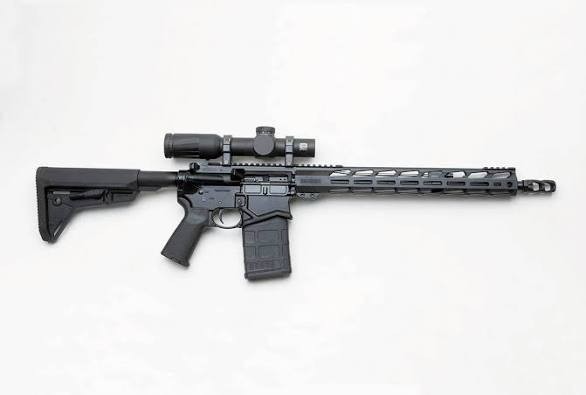
Ruger’s Small-Frame Autoloading Rifle (SFAR) was conceived with one straightforward goal: take the powerful .308 Winchester cartridge and package it in a rifle that feels and handles like an AR-15. That’s significant because while AR-15s are light, modular, and easy to carry — traits hunters love — most are chambered in .223 Remington, which many outdoorsmen consider marginal on larger game.
Enter the SFAR. It brings .308 punch without the bulk of a traditional AR-10. The trick lies in its compact design: outside of the magazine well, its dimensions are nearly identical to a typical AR-15, making it lighter and more maneuverable than most AR-10-style rifles. Hunters after quick handling, easy carry, and comfortable shooting have gravitated toward it, whether chasing hogs in thick brush or stalking deer through timber.
Familiar Feel, AR-Style Ease
On the outside, the SFAR looks and feels like an AR-15. Its stock, grip, and ergonomics are instantly recognizable to anyone familiar with the platform. It’s also lighter than many AR-15s — the rifle weighs under 7 pounds unloaded — and you can swap furniture or triggers as you would on a standard AR. Despite being chambered in .308, it shares many common AR-15-style controls and handling traits.
Under the surface, though, it’s built to handle the larger cartridge. The bolt face, lugs, firing pin, and carrier are all scaled up to work with .308 Winchester rounds, and some components — like the barrel extension and upper receiver — are proprietary. That means they aren’t compatible with AR-15 parts, and if Ruger stops making spares down the line, sourcing replacements could be a challenge.
Rugged, Functional Features
The SFAR isn’t about flash — it’s a practical, hunting-focused rifle. It comes with quality Magpul furniture, a comfortable two-stage trigger, M-LOK handguard, and an adjustable gas block that’s especially handy if you plan to run a suppressor. Semi-auto shooters will appreciate the lightweight feel, and the rifle’s controls are intuitive for anyone used to AR platforms.
Here’s a quick specs snapshot:
-
Two-stage trigger break
-
4140 steel barrel
-
15″ M-LOK handguard
-
.308 Winchester chambering with AR-10 pattern mags
-
Around 6 lb 11 oz unloaded
-
Roughly $1,000–$1,200 street price
On the Range — Pros and Cons
Out on the range, the SFAR delivers what it promises: reliable cycling and plenty of power. But there are a couple of important considerations:
-
Volume and recoil: The rifle is loud — especially with the included muzzle brake — and will punch your ears without hearing protection or a suppressor. For many shooters, a quality can will make it far more pleasant to shoot.
-
Control: It’s not the most tame rifle in rapid shot strings compared to heavier, purpose-built AR-10s, but for typical hunting scenarios where you’re not dumping an entire magazine, its light weight largely outweighs this.
-
Reliability: In testing, the rifle ran well across multiple bullet types and conditions, though certain loads might hang up in the feed if magazines or feed ramps aren’t ideal.
-
Accuracy: Expect roughly 1–1.5 MOA groups at 100 yards with quality ammo — more than sufficient for ethical hunting distances where most shots will be taken.
The Clock Is Ticking
Here’s the twist: Ruger discontinued the SFAR, so gun shops can’t order fresh ones anymore, and existing inventory will eventually dry up. The company has shifted AR-style production to facilities acquired through Anderson Manufacturing, but hasn’t yet put a lightweight AR-10 like the SFAR back into the lineup. Ruger says a version may return in the future, though details and timing aren’t certain.
That means used or on-shelf SFARs could become collectible and harder to find — and parts availability may become a concern down the road.
So Should You Grab One?
If you want a lightweight, semi-auto .308 that carries like an AR-15, there’s a strong case for picking up an SFAR while you can. It’s a capable hunter’s rifle with plenty of real-world performance, and it fills a niche many shooters appreciate. But be mindful of the pros and cons — especially noise, parts compatibility, and the fact that this version may soon be gone for good.