
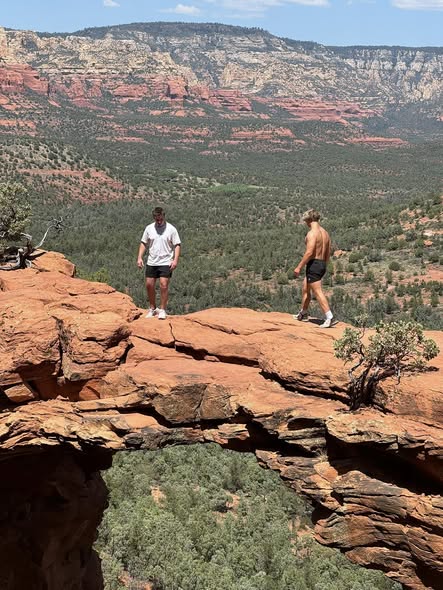
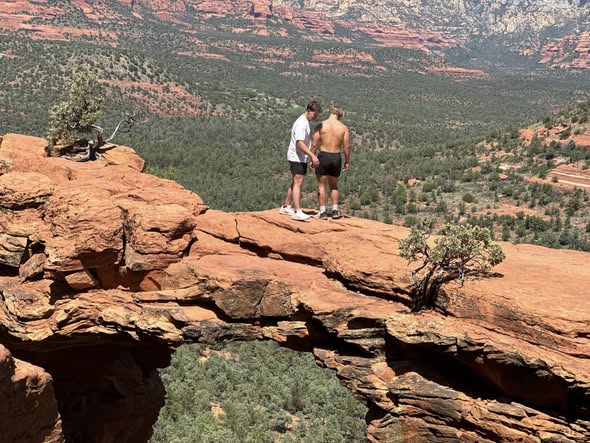
It started like so many viral moments do — a snapshot of danger, a rush of outrage, and a stranger declaring, “I already called the park ranger.”
Two kids were walking across a narrow rock bridge high above open air. No harness. No adult holding their hand in the frame. Just a breathtaking view and what looked, to some, like reckless parenting.
Cue the online fury.
But here’s another perspective: maybe not every moment of risk is neglect. Maybe sometimes, it’s growth.
Adventure Isn’t Abuse
For generations, kids climbed trees without helmets. They rode bikes without knee pads. They waded into creeks, scaled boulders, and wandered farther than today’s comfort levels might allow.
And they learned.
They learned balance. They learned awareness. They learned the quiet respect that comes from understanding nature’s edges.
Not every parent who allows a child to step onto a rock formation is “gambling with gravity.” Sometimes, they’re teaching judgment — how to test footing, how to move slowly, how to assess risk.
There’s a difference between recklessness and supervised freedom. Just because an adult isn’t in the camera frame doesn’t mean they aren’t present, watching carefully from a few steps back.
The Illusion of Control
Modern culture often treats all visible risk as unacceptable. But public lands aren’t padded playgrounds. They are wild spaces — intentionally so.
Part of visiting them is learning that nature has consequences. That wind exists. That stone shifts. That footing matters.
When children experience manageable risk under guidance, they build confidence and situational awareness. Shielding them from every elevated rock or narrow path doesn’t eliminate danger — it can delay the development of judgment.
There’s value in allowing young people to encounter challenge in controlled environments.
The Bystander Reflex
It’s understandable that someone watching might feel fear. Seeing kids near a steep drop triggers protective instincts.
But there’s also a growing trend of immediate escalation — of calling authorities not because a law was clearly broken, but because discomfort set in.
Reporting a family to a ranger over a moment of exploration raises a broader question: when does concern become overreach?
Public lands belong to everyone. They aren’t restricted to adults willing to hover three feet behind their children at all times. Families have different comfort levels, different experience levels, and different philosophies on how to raise capable, resilient kids.
Not every choice that makes a stranger anxious is a crisis.
Risk and Responsibility
Of course, cliffs are real. Falls are real. Gravity is real.
But so is parental judgment.
Many parents who allow their children to explore do so knowing their kids’ abilities. They assess balance, maturity, and conditions. They stand ready to intervene. They weigh risk versus growth.
The internet rarely sees that context. It sees a snapshot and fills in the blanks.
A Culture of Overcorrection
There’s a broader cultural tension here. On one side is the belief that safety must be maximized at all times. On the other is the idea that growth requires exposure to challenge.
If every moment of perceived danger triggers outside intervention, we risk normalizing a world where autonomy disappears and exploration is viewed as irresponsibility.
Sometimes the best course of action isn’t escalation. It’s recognizing that not every family operates by the same comfort level — and that’s okay.
Let Nature Teach
Nature is a powerful teacher. It teaches caution without lectures. It teaches respect without scolding.
Kids who explore under watchful but not suffocating guidance often emerge stronger, more confident, and more aware of their surroundings.
Maybe instead of assuming negligence, we could allow space for trust — trust in parents to know their children, and trust in kids to rise to the challenge placed before them.
Not every narrow rock bridge is a disaster waiting to happen.
Sometimes it’s just a step toward learning balance — in more ways than one.