
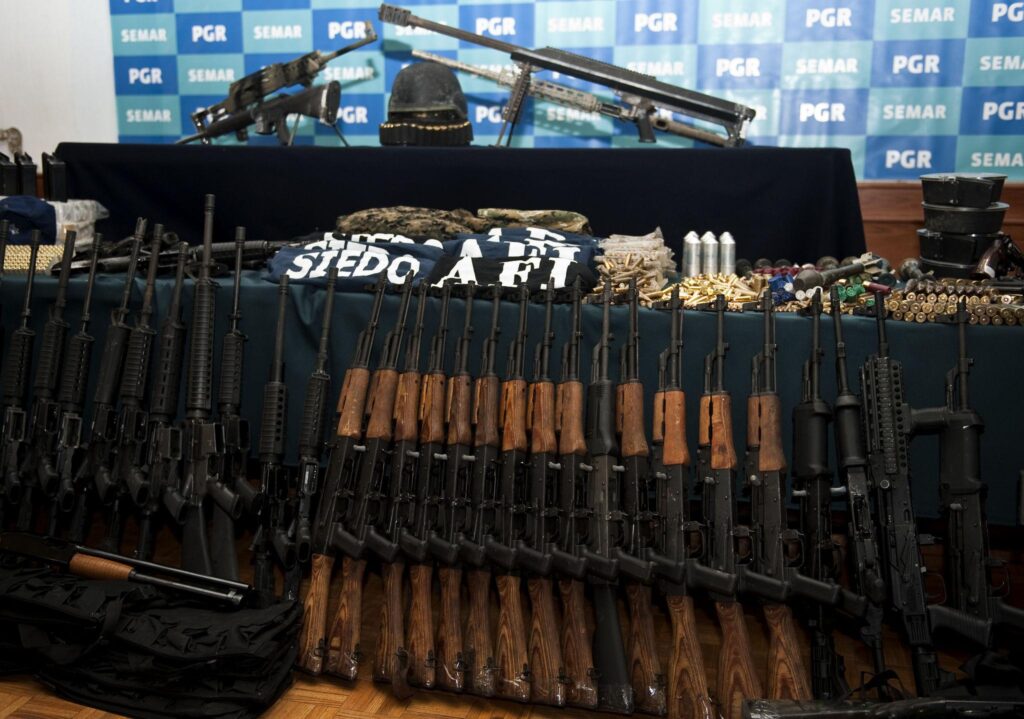
The “Iron River”: How U.S. Guns End Up in Mexican Cartel Hands

A long-running debate over gun trafficking across the U.S.–Mexico border is intensifying as lawmakers, law-enforcement officials, and policy experts argue over where the weapons used by Mexican cartels actually come from. Mexican officials have repeatedly claimed that a significant portion of cartel firearms originate in the United States, while critics argue the issue is more complex than often portrayed.
The steady movement of firearms from the United States into Mexico has been described by researchers and law-enforcement officials as the “iron river,” referring to the flow of guns south across the border. According to the U.S. Government Accountability Office, Mexican government estimates suggest that roughly 200,000 firearms are smuggled from the United States into Mexico each year, fueling violence linked to organized crime.
The issue has become one of the most politically charged debates involving gun policy, border security, and cartel violence.
How Guns Are Trafficked Across the Border
Most firearms trafficked into Mexico begin as legal purchases inside the United States. Investigators say traffickers frequently rely on a practice known as straw purchasing, where someone who can legally buy a firearm purchases it on behalf of another person who cannot legally obtain it or intends to smuggle it into Mexico.
According to the Bureau of Alcohol, Tobacco, Firearms and Explosives, trafficking networks often move weapons through established smuggling routes connecting border states such as Texas, Arizona, and California to cartel-controlled regions of Mexico.
ATF tracing data has shown that many of the firearms recovered in Mexico originated from those states. In fact, law-enforcement analysis cited by ATF indicates that Texas alone accounted for roughly 43% of traced firearms recovered in Mexico, with Arizona and California also serving as major sources.
Smugglers often hide weapons in vehicles, cargo shipments, or concealed compartments before transporting them across the border.
What the Numbers Actually Show
Statistics about cartel firearms are one of the most disputed aspects of the debate.
Mexican officials frequently cite studies showing that about 70% of firearms recovered in Mexico and submitted for tracing were originally purchased in the United States, according to firearm tracing data from the Bureau of Alcohol, Tobacco, Firearms and Explosives.
However, analysts note that this statistic applies only to guns that Mexican authorities choose to submit for tracing through the United States.
Researchers examining the issue have pointed out that many seized weapons are never submitted for tracing, meaning the 70% figure reflects only a portion of the total weapons recovered. According to the U.S. Government Accountability Office, incomplete tracing data makes it difficult to determine the exact percentage of cartel firearms originating from the United States.
As a result, experts say the true number remains a subject of ongoing debate.
Why Cartels Seek American Firearms
Mexican drug cartels are among the most heavily armed criminal organizations in the world. They frequently use rifles, pistols, and military-style weapons in conflicts with rival groups and government forces.
American firearms are attractive to traffickers for several reasons. The United States has a large civilian firearms market and shares a long border with Mexico, making cross-border smuggling easier.
According to research published by the Small Arms Survey, North America’s extensive commercial gun market creates opportunities for traffickers to acquire weapons through both legal purchases and illegal resale.
Investigators have seized a wide range of firearms from cartel members, including AR-15-style rifles and AK-type rifles.
Smuggling Cases Continue to Surface
Authorities continue to uncover gun trafficking operations along the border.
In one case reported by U.S. Customs and Border Protection, officers discovered 44 handguns hidden inside a sports car attempting to cross into Mexico at a Texas port of entry.
Other investigations have uncovered even larger operations. Federal prosecutors announced charges in another case involving suspects accused of attempting to transport hundreds of firearms concealed inside cargo shipments bound for Mexico.
Law-enforcement officials say these cases illustrate how organized trafficking networks move weapons south in large quantities.
A Political Battle on Both Sides of the Border
The issue of American firearms reaching Mexican cartels has become a major point of tension between policymakers in both countries.
Mexican officials have repeatedly called on the United States to tighten gun laws and crack down on trafficking networks. Some Mexican leaders have even attempted legal action against U.S. gun manufacturers, arguing that firearm sales in the United States contribute to cartel violence.
Meanwhile, gun-rights advocates in the United States argue that the problem stems primarily from criminal smuggling networks and border-security failures rather than legal gun ownership.
They also point out that cartels obtain weapons from a variety of sources, including international black markets and theft from military or police stockpiles.
A Complex Problem Without an Easy Fix
Despite years of enforcement efforts, the flow of firearms across the U.S.–Mexico border remains a difficult challenge for both countries.
American and Mexican authorities continue to work together to disrupt trafficking networks, trace seized firearms, and investigate cross-border smuggling operations.
But as long as cartels remain heavily armed and demand for weapons persists, experts say the so-called “iron river” of guns flowing south is likely to remain one of the most complex security challenges facing North America today.