
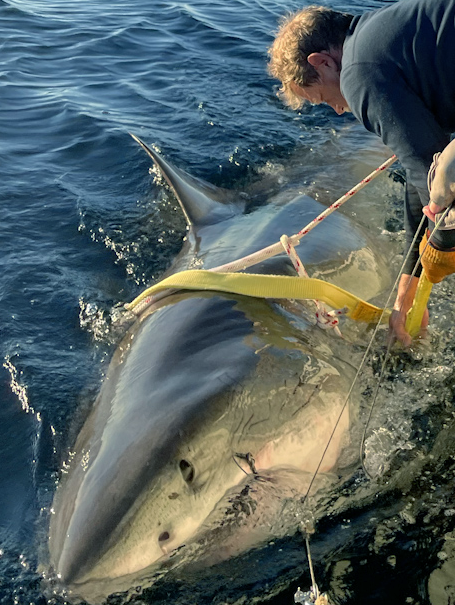
“Contender” the Largest Male Great White Ever Recorded Spotted Off Florida Coast

A Giant Predator Returns to the Spotlight
One of the largest male great white sharks ever recorded in the Atlantic has been spotted once again—this time off the coast of Florida.
The shark, known as “Contender,” has been tracked by researchers from OCEARCH, and his size alone is what’s turning heads.
Contender measures roughly 13 feet 9 inches long and weighs an estimated 1,600 pounds, making him one of the largest male great whites ever tagged and studied in the region.
How Researchers Found Him
Contender was originally tagged by OCEARCH scientists during a research expedition in the North Atlantic. The organization uses satellite tracking technology to monitor the movements of large sharks, providing valuable insight into migration patterns.
According to tracking data released by OCEARCH, Contender has been moving along the eastern seaboard, recently pinging off the Florida coastline.
These “pings” occur when the shark’s dorsal fin breaks the surface, allowing the satellite tag to transmit its location.
Why This Shark Matters
Great white sharks are among the ocean’s most studied predators, but large males like Contender are relatively rare to encounter and track.
According to research from the National Oceanic and Atmospheric Administration, great whites can grow to impressive sizes, but females typically outgrow males, making a shark of Contender’s size especially notable.
Tracking sharks like Contender helps scientists better understand:
-
Migration routes
-
Feeding behavior
-
Breeding patterns
-
Habitat use
This data plays a key role in conservation efforts.
What Brings Great Whites to Florida
While great white sharks are often associated with colder waters, they frequently travel along the Atlantic coast.
Florida’s waters serve as part of a seasonal migration route, particularly during cooler months when sharks move south.
According to the National Oceanic and Atmospheric Administration, these migrations are often tied to water temperature and food availability.
That means sightings like this, while rare, are not entirely unexpected.
Should Beachgoers Be Concerned?
Despite the size and reputation of great white sharks, attacks on humans remain extremely rare.
According to data from the Florida Museum of Natural History, millions of people enter the ocean each year, while shark bites remain statistically uncommon.
Experts emphasize that sharks are not actively targeting humans.
Most encounters are believed to be cases of mistaken identity.
A Reminder of What’s Out There
Still, the presence of a nearly 14-foot, 1,600-pound predator just offshore is a powerful reminder of the ocean’s wild side.
For researchers, Contender represents a valuable source of data.
For the public, he’s a glimpse into a world that most people never see—a top predator moving silently just beneath the surface.
Tracking the Ocean’s Giants
OCEARCH continues to monitor Contender’s movements in real time, allowing anyone to follow his journey along the coast.
Each new ping adds to a growing body of knowledge about one of the ocean’s most iconic species.
And as long as sharks like Contender are out there, the Atlantic Ocean will never be just another stretch of water—it will remain one of the last truly wild frontiers on Earth.