
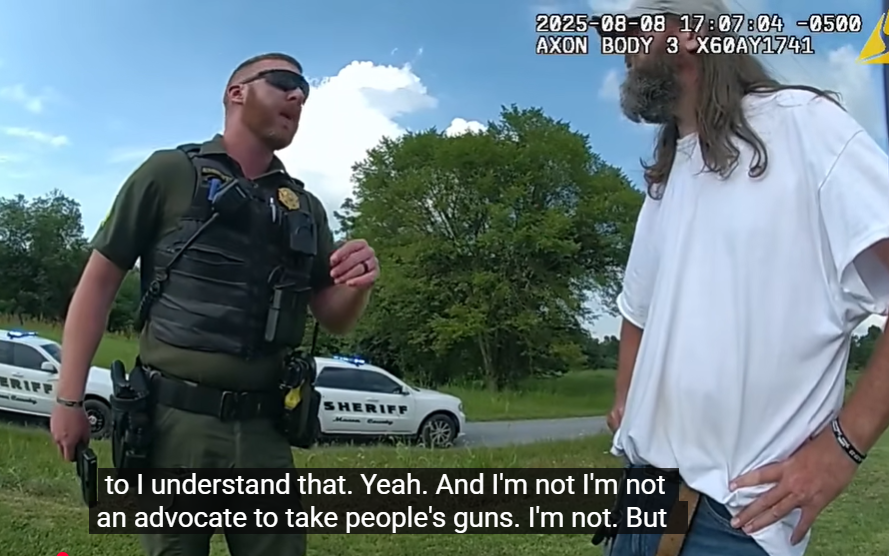
Neighbor Complains, Cops Show Up—Then Take Man’s Gun, Mock His Rights, and Arrest Him
In rural Macon County, a dispute between neighbors over gunfire has sparked a much larger conversation—one that goes beyond noise complaints and into questions about property rights, law enforcement authority, and constitutional protections.
At the center of it is a man identified as Zebulon, a rural landowner who, by all accounts, was doing something common across much of Tennessee: shooting firearms on his own property.
A Neighbor Complaint Turns Into Police Response
According to the account, the situation began when a nearby neighbor called law enforcement, claiming to have heard gunshots coming from Zebulon’s property.
The neighbor reportedly admitted he did not actually see any shots being fired into the air but said he “assumed” that was happening. That assumption was enough to trigger a response.
In many rural areas, target shooting on private land is legal, provided it’s done safely and in accordance with local regulations.
But complaints—especially involving firearms—tend to draw immediate attention.
Deputies Arrive—But the Situation Changes
When deputies arrived on the property, Zebulon was not actively shooting. Instead, he was mowing his field.
According to the account, officers told him they were not there to take his firearm.
But the interaction escalated.
At some point during the encounter, deputies took possession of his gun—contradicting their initial statement. While standing on his property, they then reportedly requested identification, despite Zebulon maintaining that he had not fired shots into the air or committed any illegal act.
A Constitutional Flashpoint
What began as a noise complaint quickly turned into something more serious.
Zebulon invoked his Fourth Amendment rights, asking officers to leave his property.
That request, according to the account, was not honored.
The situation escalated further when officers allegedly made statements indicating they were not concerned with those constitutional protections—remarks that, if accurate, are likely to draw scrutiny.
The Legal Gray Area
Encounters like this often fall into complicated legal territory.
On one hand:
- Law enforcement can respond to complaints and investigate potential safety issues
- Reports involving firearms are typically treated with urgency
On the other:
- Property owners have rights regarding searches, seizures, and unlawful entry
- Seizing property without clear cause can raise constitutional concerns
The key issue often comes down to whether officers had reasonable suspicion or probable cause to take further action.
If not, the legality of the encounter becomes questionable.
A Common Rural Reality
In places like Macon County, shooting on private land isn’t unusual.
For many landowners, it’s part of everyday life—whether it’s:
- Practicing with firearms
- Hunting preparation
- General recreational shooting
But as more people move into rural areas, conflicts like this are becoming more common.
What one person sees as normal, another may see as disruptive—or even dangerous.
Bigger Questions Moving Forward
This situation raises broader questions that extend well beyond a single property line:
- How should law enforcement handle complaints based on assumptions rather than direct observation?
- Where is the line between investigation and overreach?
- How are constitutional protections applied in real-world encounters?
These are questions that don’t have simple answers—but they matter, especially in areas where personal freedom and property rights are deeply valued.
The Bottom Line
What started as a neighbor complaint about gunfire has turned into a situation that touches on some of the most debated issues in the country—rights, enforcement, and trust.
For some, it’s a case of officers responding to a potential safety concern.
For others, it’s an example of overreach on private property.
Either way, it’s a reminder that even in quiet rural areas, the balance between individual rights and public safety isn’t always as clear-cut as it seems.