
Night Vision Was Just the Beginning: The Rise of Thermal Optics in Hog Hunting

There was a time when hog hunting at night meant guesswork.
You listened more than you saw. You relied on moonlight, feeders, and luck. If a sounder slipped through the brush undetected, you might never know they were there.
Then came night vision.
And now?
Thermal optics have changed the game completely.
Seeing What Was Never Visible Before
Thermal optics don’t rely on light.
They detect heat signatures.
That means:
- No dependence on moonlight
- No need for visible illumination
- No hiding in thick brush
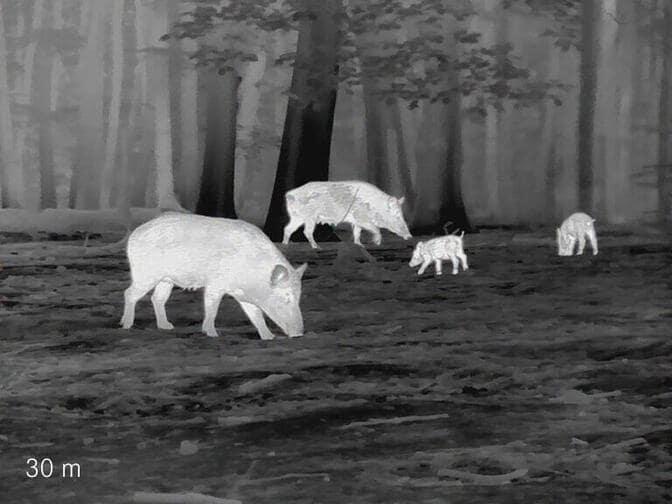
A hog standing in knee-high grass at midnight might be completely invisible to the naked eye.
Through thermal?
It lights up like a spotlight.
That’s the difference.
Why Hog Hunters Adopted Thermal So Fast
Feral hogs are one of the most destructive invasive species in Texas. According to the Texas A&M AgriLife Extension Service, hogs cause millions of dollars in damage each year through crop destruction, erosion, and habitat loss.
They’re also:
- Primarily nocturnal
- Highly intelligent
- Quick to adapt to pressure
Traditional hunting methods often fall short.
Thermal optics gave hunters something they never had before:
A consistent advantage.
The Real Advantage: Detection
The biggest benefit of thermal isn’t shooting.
It’s finding hogs in the first place.
With thermal, you can:
- Scan large areas quickly
- Detect animals at long distances
- Spot movement instantly
Even in total darkness, you can locate an entire sounder moving through a field.
That changes everything.
From Opportunity to Efficiency
Before thermal, a successful hog hunt often meant:
- Sitting over feeders
- Waiting for hours
- Hoping hogs showed up
Now, it’s active.
Hunters can:
- Locate hogs
- Move into position
- Engage with purpose
It’s less waiting—and more hunting.
And for landowners dealing with hog damage, that efficiency matters.
Thermal vs. Night Vision
Night vision was a big step forward—but thermal took it further.
Night vision:
- Requires ambient light
- Can struggle in dense brush
- Provides more detail—but less detection
Thermal:
- Works in complete darkness
- Sees through light cover
- Excels at locating animals
Many hunters still use both—but thermal is what finds the target.
The Impact on Hog Populations
With better technology comes better results.
Thermal optics have made it easier to:
- Remove multiple hogs in a single night
- Target entire sounders
- Hunt year-round
According to data from the USDA Animal and Plant Health Inspection Service, controlling feral hog populations requires aggressive, consistent efforts due to their high reproduction rates.
Thermal has become one of the most effective tools in that effort.
But it hasn’t eliminated the problem.
Hogs are still expanding.
They’re just harder to manage without tools like this.
The Cost Barrier
There’s no way around it—thermal optics aren’t cheap.
Quality setups can range from:
- $2,000 to $6,000+
That’s a major investment.
But for serious hog hunters, guides, and land managers, the return can justify the cost:
- Increased success
- Reduced crop damage
- More efficient hunts
It’s not for everyone—but it’s growing fast.
The Ethical Debate
As with any technology, thermal optics have sparked debate.
Some argue it:
- Removes challenge from the hunt
- Gives too much of an advantage
Others argue:
- Hog hunting is population control, not sport
- Efficiency is more important than difficulty
Both sides have a point.
But in Texas, where hog populations continue to cause widespread damage, many landowners lean toward effectiveness over tradition.
The Future of Night Hunting
Thermal technology isn’t slowing down.
It’s improving.
New optics offer:
- Better resolution
- Longer detection ranges
- More compact designs
What was once a niche tool is quickly becoming mainstream.
The Bottom Line
Thermal optics didn’t just improve hog hunting.
They transformed it.
They turned darkness into daylight.
They shifted hunting from waiting to action.
And they gave hunters the ability to see what was always there—but never visible.
Because in the world of hog hunting…
The advantage goes to the one who can see first.