
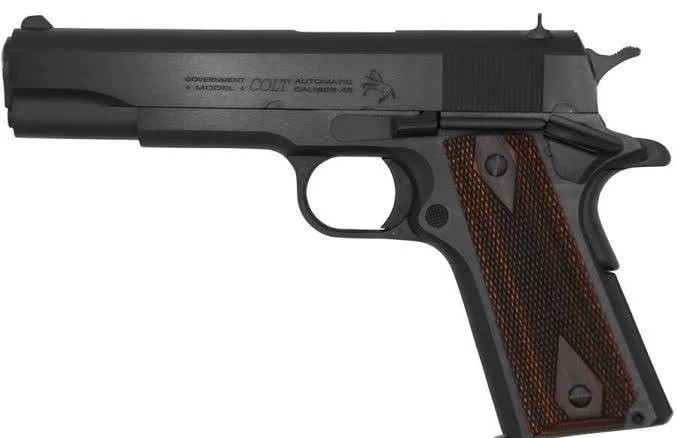
In a handgun market dominated by polymer frames, striker-fired triggers, optics-ready slides, and high-capacity 9mm magazines, one platform refuses to fade into history: the 1911 — and its modern evolution, the 2011 — chambered in .45 ACP.
For more than a century, the 1911 has remained relevant. And despite endless debates about capacity, recoil, and “modernization,” many experienced shooters still argue that the 1911 and 2011 in .45 ACP remain the king of handguns.
Here’s why.
1. A Century of Proven Performance
The .45 ACP wasn’t born out of theory — it was born out of battlefield necessity. After early 20th-century military experience revealed shortcomings in smaller calibers, the U.S. adopted the .45 ACP cartridge alongside John Browning’s 1911 design.
That pairing would go on to serve through two World Wars, Korea, Vietnam, and decades of law enforcement and civilian carry.
The 230-grain .45 bullet moves slower than most modern 9mm defensive loads, but it carries significant mass and diameter. For many shooters, that combination delivers confidence. It’s not about hype — it’s about a cartridge that has been trusted under real-world pressure for generations.
While ballistics science has evolved, the .45 ACP continues to meet modern defensive standards. And the legacy behind it carries weight that no spec sheet can replicate.
2. The Trigger That Still Sets the Standard
Ask any seasoned shooter what separates the 1911 from most modern pistols, and the answer is immediate: the trigger.
A well-built 1911 has one of the cleanest, crispest triggers in the handgun world. Minimal take-up. A defined wall. A sharp break. Short, tactile reset.
Unlike many striker-fired systems that rely on partially pre-cocked mechanisms, the 1911 is a true single-action design. The hammer is fully cocked, and the trigger performs one task — releasing it. The result is a trigger pull that feels precise and predictable.
The 2011 platform preserves that legendary trigger while modernizing everything else. By incorporating a double-stack frame, improved grip modules, and competition-ready configurations, the 2011 merges old-school trigger excellence with contemporary performance expectations.
In competitive shooting circles, 2011 pistols dominate for a reason. When speed and accuracy matter, trigger quality matters.
And the 1911 design still leads.
3. Ergonomics That Refuse to Age
The 1911’s grip angle has long been praised for its natural pointability. For many shooters, the gun aligns instinctively with the eye. It feels balanced in the hand — neither top-heavy nor awkward.
Despite being designed over 100 years ago, the 1911 remains surprisingly ergonomic. Its slim single-stack frame fits a wide range of hand sizes, and the placement of the thumb safety and grip safety encourages deliberate, confident handling.
The 2011 builds on that foundation by offering increased magazine capacity without sacrificing balance. Modern grip modules provide improved texture and recoil control while maintaining that familiar 1911 geometry.
In a world obsessed with modularity, the 1911’s original design still feels remarkably intuitive.
4. Recoil That’s Strong — But Predictable
Critics often point to recoil as a drawback of the .45 ACP. It’s true that a 230-grain bullet generates more energy than most 9mm loads. But recoil is more nuanced than raw numbers.
Many shooters describe .45 recoil as a “push” rather than a sharp snap. The weight of a steel-frame 1911 absorbs much of that impulse, and the longer slide travel spreads the energy over time. The result is a recoil pattern that feels steady rather than violent.
The 2011 platform refines this even further. Modern recoil systems, tuned springs, and improved grip design can make the .45 surprisingly manageable — especially in full-size pistols.
For experienced shooters, that deliberate recoil rhythm becomes predictable and controllable.
It’s not about rapid-fire magazine dumps.
It’s about confident, accurate follow-up shots.
5. Legacy, Craftsmanship, and Identity
Beyond performance, the 1911 carries something that polymer pistols rarely do: identity.
A 1911 isn’t just a tool. It’s craftsmanship. Steel and wood. Checkering and machining. It represents an era when mechanical design prioritized durability and refinement.
Owning a 1911 in .45 ACP often feels like owning a piece of history. Even modern 2011 platforms, though technologically advanced, still trace their lineage directly to Browning’s original blueprint.
While striker-fired pistols emphasize efficiency and practicality, the 1911/2011 emphasizes precision and tradition.
There’s pride in running a platform that has stood the test of time.
The Modern Debate
None of this dismisses the advantages of modern 9mm platforms. Higher capacity, lighter recoil, lighter weight, and logistical efficiency are real benefits. Many agencies and shooters have chosen 9mm for those reasons.
But “king” isn’t always defined by capacity alone.
The 1911 and 2011 in .45 ACP remain competitive because they offer:
-
A proven, authoritative cartridge
-
A world-class trigger system
-
Timeless ergonomics
-
Predictable recoil control
-
A legacy unmatched in handgun history
In a marketplace constantly chasing the next innovation, the 1911 platform continues to hold its ground.
It may not be the newest design on the shelf.
But for many shooters, it doesn’t need to be.
The king doesn’t have to shout.
It simply endures.