
Is It Time for More Aggressive Measures to Control Wild Pigs in Texas?

Wild pigs in Texas aren’t just a nuisance anymore—they’re a full-blown crisis. With an estimated population in the millions, feral hogs are tearing up farmland, destroying native habitat, and costing landowners and the state billions of dollars in damage every year.
So the question is starting to shift.
It’s no longer how do we manage them—it’s are current methods even enough anymore?
The Scale of the Problem Is Massive
Feral hogs reproduce at an alarming rate. A single sow can produce multiple litters each year, and populations can double in a short period of time if left unchecked.
According to the Texas Parks and Wildlife Department, feral hogs cause widespread damage to:
- Crops and pastureland
- Fencing and infrastructure
- Native ecosystems and wildlife habitat
The issue isn’t isolated—it’s statewide.
And traditional hunting alone hasn’t been enough to slow them down.
Recreational Hunting Isn’t Controlling the Population
Texas has some of the most liberal hog hunting regulations in the country. In many areas, hogs can be hunted year-round with no bag limits.
But even with that level of access, the population continues to grow.
Why?
Because recreational hunting typically removes only a portion of the population. According to research referenced by the Texas A&M AgriLife Extension Service, you often need to remove 60–70% of a hog population annually just to keep numbers stable.
Most hunting efforts fall well short of that.
Trapping Is One of the Most Effective Tools
If there’s one method that consistently shows results, it’s trapping.
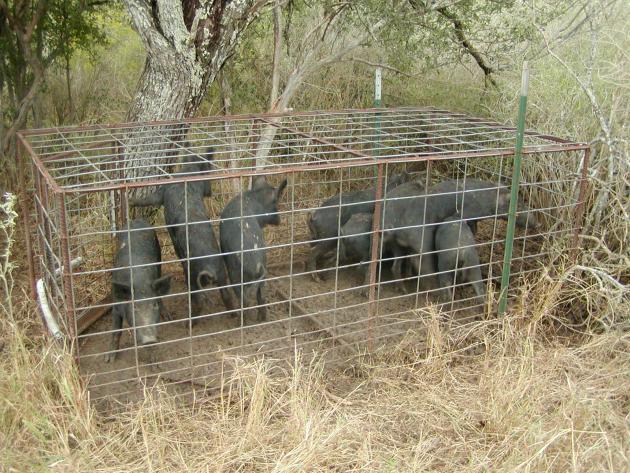
Large corral traps can remove entire sounders (groups of hogs) at once, which is critical for reducing population growth.
According to the Texas A&M AgriLife Extension Service, trapping is one of the most effective and practical methods for large-scale hog control when done correctly.
But it requires:
- Time
- Equipment
- Consistent monitoring
It’s effective—but it’s not easy.
Aerial and “Industrial” Hunting Is Expanding
In recent years, more aggressive methods have gained attention—particularly aerial hunting.
Helicopter hog hunting, often referred to as “aerial gunning,” allows hunters to cover large areas quickly and remove multiple animals in a short amount of time.
According to the Texas Parks and Wildlife Department, aerial control programs have proven effective in reducing populations in targeted areas, especially large ranches.
Some landowners are also turning to:
- Night vision and thermal hunting
- Coordinated group hunts
- Professional eradication services
These methods are far more aggressive than traditional hunting—and far more effective in certain situations.
The Controversy Around Poison
One of the most debated control methods is the use of toxicants, or poison.
Compounds like sodium nitrite have been studied as a potential way to reduce hog populations on a large scale. The idea is simple: deliver bait that is lethal to hogs but less harmful to other wildlife.
However, the use of poison comes with major concerns.
According to the Environmental Protection Agency, toxicants must be carefully regulated to prevent:
- Accidental poisoning of non-target species
- Environmental contamination
- Risks to pets or livestock
Public pushback has also been strong, with concerns about unintended consequences and safety.
As a result, widespread use of poison remains controversial and limited.
Why More Aggressive Measures Are Being Discussed
The reality is simple—current efforts are not keeping up with population growth.
As damage increases, landowners and policymakers are being forced to consider options that were once seen as too extreme.
The conversation now includes:
- Expanding aerial control programs
- Increasing funding for large-scale trapping
- Revisiting controlled toxicant use
- Coordinating regional eradication efforts
This isn’t about sport anymore—it’s about control.
The Balance Between Control and Responsibility
While aggressive measures may be necessary, they also come with responsibility.
Any large-scale solution must consider:
- Environmental impact
- Safety for other wildlife and livestock
- Ethical considerations
According to the Texas Parks and Wildlife Department, effective hog management requires a combination of methods—not just one solution.
There is no silver bullet.
The Bottom Line
Wild pigs in Texas aren’t slowing down—and neither is the damage they cause.
Trapping, aerial hunting, and coordinated efforts are proving to be the most effective tools right now. Poison remains a controversial option, but one that continues to be discussed as the problem grows.
The real question isn’t whether more aggressive measures are needed.
It’s whether we’re willing to implement them at the scale required to actually make a difference.
Because at this point, doing nothing—or doing too little—is no longer an option.