
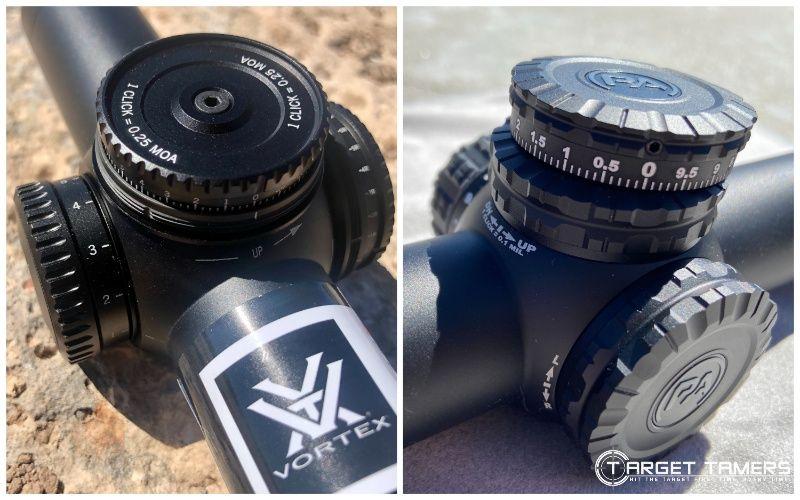
MIL vs. MOA: For the Average Shooter, Which Is Better—and Does It Really Matter?

If you’ve spent any time looking at rifle scopes, you’ve probably run into the MIL vs. MOA debate. It’s one of those topics that gets people fired up—but for most shooters, it doesn’t need to be complicated.
Both systems do the same thing. They help you measure distance and adjust your scope so you can hit your target.
The real question is: which one makes more sense for you?
What MIL and MOA Actually Are
At their core, both MIL (milliradian) and MOA (minute of angle) are angular measurement systems.
They don’t measure distance directly—they measure how much your bullet impacts relative to your point of aim so you can make corrections.
MOA is based on degrees. One MOA equals roughly 1 inch at 100 yards (technically 1.047 inches).
MIL is based on the metric system. One MIL equals 3.6 inches at 100 yards.
Instead of overthinking it, just remember:
- MOA = smaller, more granular adjustments
- MIL = larger, simpler increments
Both work. Both are accurate.
Why MOA Feels More Natural to Some Shooters
MOA has been around longer in the U.S., and many hunters grew up using it.
It’s often easier to understand because it relates closely to inches:
- 1 MOA ≈ 1 inch at 100 yards
- 2 MOA ≈ 2 inches at 100 yards
According to fundamentals taught through the National Shooting Sports Foundation, simpler mental math can help shooters make quicker adjustments in the field.
If you think in yards and inches, MOA tends to feel intuitive.
Why MIL Has Become So Popular
MIL systems have gained popularity, especially among precision shooters.
The main advantage is simplicity in scaling:
- 0.1 MIL = 0.36 inches at 100 yards
- Adjustments are often in tenths (0.1 MIL clicks)
According to training concepts used by the U.S. Marine Corps, MIL-based systems are widely used in military and long-range shooting because they work cleanly with range estimation and spotting corrections.
Many shooters find MIL easier when working with a spotter or calling shots.
The Real Advantage: Matching Your Scope
Here’s where most people get it wrong.
The biggest factor isn’t MIL vs. MOA—it’s consistency.
Your scope should have:
- Matching turrets and reticle (MIL/MIL or MOA/MOA)
Mixing systems creates confusion and slows you down.
Modern scopes typically match both, which eliminates most of the difficulty.
For the Average Shooter—Does It Really Matter?
For most hunters and casual shooters, the answer is simple:
No, it doesn’t matter nearly as much as people think.
If you’re:
- Shooting inside 300 yards
- Hunting typical game
- Not dialing constantly for long-range shots
You likely won’t notice a real-world difference.
According to shooting fundamentals emphasized by the National Deer Association, shot placement and practice matter far more than the measurement system you use.
Where It Does Start to Matter
The MIL vs. MOA debate becomes more relevant when:
- Shooting long range (500+ yards)
- Dialing adjustments frequently
- Working with a spotter
In those cases, efficiency and communication become more important.
MIL often gets the edge in those scenarios—but again, it comes down to what you’re comfortable with.
Learning Curve and Preference
Some shooters prefer MOA because it feels familiar.
Others prefer MIL because it’s cleaner and widely used in modern systems.
Neither is wrong.
What matters is:
- Understanding your system
- Practicing with it
- Being consistent
Switching back and forth is where problems happen.
The Bottom Line
MIL vs. MOA isn’t about which is “better”—it’s about which one you learn and use well.
For the average shooter, either system will get the job done just fine.
If you’re just starting out, pick one, stick with it, and focus on fundamentals.
Because at the end of the day, it’s not the system that hits the target—it’s the shooter behind it.