
Predator Swamping – For a Few Weeks, Predators Win—Then Whitetail Deer Flip the Script

Every spring, something happens in the whitetail woods that most people never see—but it’s one of the most important survival strategies in North America.
For a brief window, predators have the upper hand.
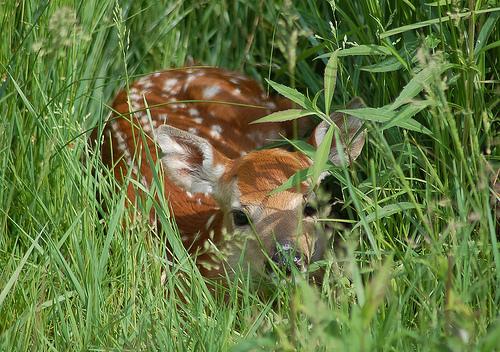
Fawns are born weak, vulnerable, and almost completely defenseless. They don’t run. They don’t fight. Their only defense is to lie still and hope they aren’t found.
And during those first days?
Many of them are.
But here’s the part that changes everything:
It doesn’t last.
The Short Window Where Predators Dominate
When white-tailed deer drop fawns, it’s not spread out over months like you might expect.
It happens all at once.
Within a tight window in late spring, does across a region give birth in near synchronization. Suddenly, the woods are filled with newborn fawns—hidden in tall grass, tucked into brush, and scattered across the landscape.
For predators like coyotes, bobcats, bears, and even birds of prey, it’s a target-rich environment.
And they take advantage of it.
During those first couple of weeks:
- Fawns rely entirely on camouflage
- They have little to no mobility
- They are highly susceptible to scent detection
Predation rates spike.
From the outside, it can look brutal—and it is.
But what looks like vulnerability is actually part of a much bigger strategy.
Predator Swamping: Nature’s Numbers Game
This phenomenon has a name:
Predator swamping.
Instead of trying to avoid predators entirely, whitetail deer overwhelm them.
By dropping the majority of fawns in a short, concentrated period, deer create a situation where predators simply cannot keep up. Even if predators are successful early, there are far more fawns being born than can realistically be taken.
It’s not about preventing predation.
It’s about outpacing it.
Think of it like this:
If fawns were born slowly over several months, predators would have a steady, manageable food source—and could impact the population much more effectively.
But when hundreds—or thousands—of fawns hit the ground at the same time?
Predators get overwhelmed.
Why It Works So Well
The strategy is simple—but incredibly effective.
Predators are limited by:
- Time
- Energy
- Territory
They can only hunt so much, cover so much ground, and consume so many animals.
Even at peak efficiency, they hit a ceiling.
Meanwhile, fawns keep coming.
And once that initial surge passes, everything shifts.
The Turning Point: When Fawns Start Fighting Back
After just a few weeks, fawns begin to change.
They:
- Gain strength
- Develop coordination
- Start following their mothers
- Become more alert and responsive
That’s when survival rates begin to climb.
What was once easy prey becomes much harder to catch.
The hiding strategy gives way to mobility—and mobility changes the game.
Predators that had the advantage early suddenly find themselves chasing animals that are faster, stronger, and far more aware.
The window closes.
The Illusion of High Predation
This is where many people misunderstand what’s happening.
Seeing high predation early on can create the impression that fawn populations are being heavily reduced.
But in reality, the system is working exactly as intended.
Even if predators take a significant number of fawns in those first weeks, they are not able to make a lasting dent in the overall population.
Because they were never meant to.
The numbers were never in their favor.
A Strategy Built Over Generations
Predator swamping isn’t random.
It’s the result of generations of natural selection refining what works.
Deer that synchronized births had better survival outcomes.
Over time, that behavior became the norm.
It’s a reminder that survival in the wild isn’t always about being stronger or faster.
Sometimes, it’s about timing.
What This Means for Hunters and Land Managers
For hunters and wildlife managers, understanding this cycle is critical.
It highlights:
- The resilience of deer populations
- The limited long-term impact of predation alone
- The importance of habitat quality during fawning season
Good cover, proper nutrition, and low stress environments can significantly improve fawn survival during that vulnerable window.
Because while predator swamping handles the numbers…
Habitat helps tip the balance even further.
The Bigger Picture
Nature doesn’t operate on fairness.
It operates on effectiveness.
For a few short weeks, predators have the advantage—and they use it.
But they’re not designed to win long-term.
Whitetail deer aren’t trying to eliminate predation.
They’re simply overwhelming it.
The Bottom Line
At first glance, fawning season looks like a period of vulnerability.
But it’s actually one of the most powerful survival strategies in the wild.
By flooding the landscape with more fawns than predators can handle, whitetail deer ensure that enough survive to carry the population forward.
Because in the end…
It’s not about avoiding predators.
It’s about making sure they can’t keep up.