
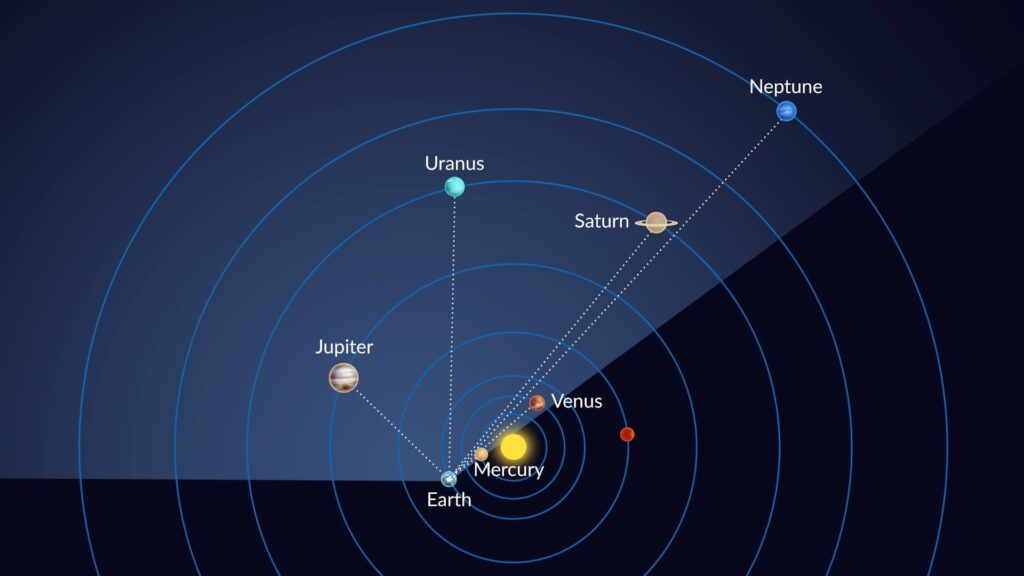
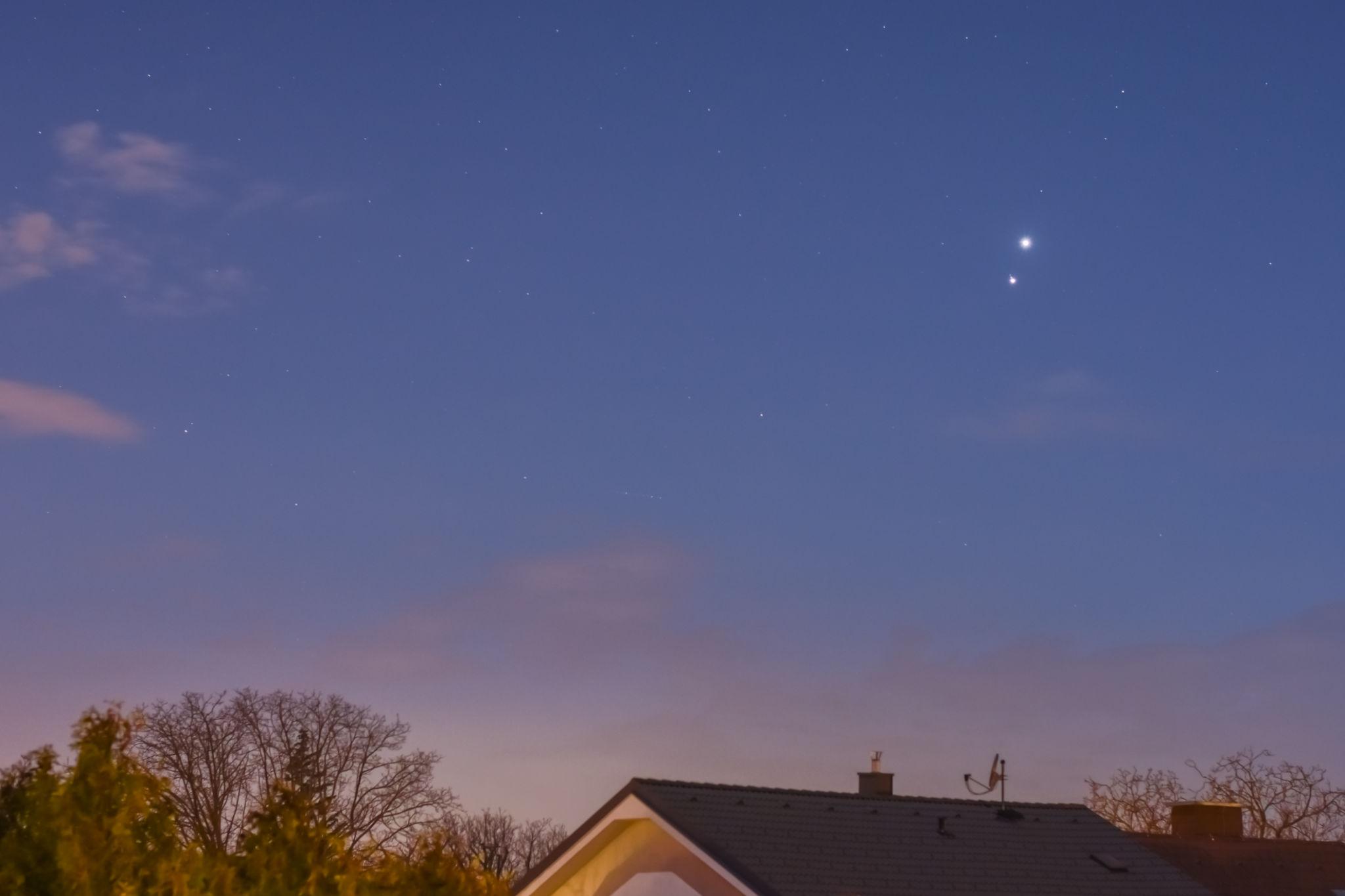
Skywatchers across Texas and much of the Northern Hemisphere have a rare opportunity this week to see six planets appearing together in the evening sky. This event, often called a “planetary parade,” will reach peak visibility on February 28, when Mercury, Venus, Saturn, Jupiter, Uranus, and Neptune form a sweeping arc above the western horizon after sunset. According to National Geographic, these alignments provide a striking visual display of multiple planets appearing in one portion of the sky, even though the planets themselves remain millions or billions of miles apart.
What Is a Planetary Parade?
Despite the dramatic name, planetary parades are not perfectly straight alignments. Instead, they occur because the planets in our solar system orbit the Sun along a similar flat plane called the ecliptic. From Earth’s viewpoint, this shared orbital path makes the planets appear to line up along a curved path in the sky.
Jason Steffen, assistant professor of physics and astronomy at the University of Nevada, Las Vegas, explained to National Geographic that the effect is largely a matter of perspective. He compared it to standing on a pool table the size of a billiard ball. Even though the balls are spread out across the table, they would appear aligned in a line from that vantage point (National Geographic).
These alignments occur periodically, but six-planet displays are less common than smaller groupings. According to astronomical tracking reported by National Geographic, a similar six-planet alignment occurred in January 2025, while a four-planet grouping was visible in August of that year.
When and How to See the Planets
The best time to view the planetary parade is shortly after sunset, when the planets first become visible above the western horizon. However, timing is critical. Mercury, Venus, Saturn, and Neptune remain low in the sky and set quickly, often disappearing within one to two hours after sunset. Jupiter and Uranus, by contrast, appear higher and remain visible longer into the evening.
Some planets are easy to see with the naked eye. Venus and Jupiter are especially bright and can stand out clearly even in areas with moderate light pollution. Mercury is more difficult to spot due to its small size and proximity to the horizon.
Steffen noted in National Geographic that Mercury can be challenging for observers who are unfamiliar with its appearance, as it only becomes visible briefly near sunset or sunrise. Uranus and Neptune are even harder to see and typically require binoculars or a telescope to identify clearly (National Geographic).
Astronomers recommend finding an open viewing area with a clear western horizon and minimal light pollution. Using a star chart or astronomy app can also help distinguish planets from stars.
A Regular Event — But Still Worth Watching
Although planetary parades are visually impressive, they are not rare in astronomical terms. The planets orbit the Sun at different speeds, and from time to time, their positions align from Earth’s perspective. According to National Geographic, these groupings are part of the normal motion of the solar system and do not represent any unusual or dangerous event.
Scientists emphasize that planetary alignments have no meaningful physical effect on Earth. Despite myths and speculation, the gravitational influence of distant planets is negligible compared to the effects of the Moon and the Sun.
These events are important primarily for observation and scientific interest, rather than any physical impact on Earth itself.
Alignments Have Played a Role in Space Exploration
While planetary alignments do not affect Earth directly, they have played an important role in space exploration. According to Steffen’s explanation in National Geographic, a similar alignment of the outer planets in the late 1970s created a rare opportunity for NASA to launch the Voyager I and Voyager II spacecraft.
Because the planets were positioned on the same side of the solar system, NASA engineers were able to use gravity assist maneuvers, allowing the spacecraft to travel from one planet to the next more efficiently. This alignment enabled the Voyager missions to explore Jupiter, Saturn, Uranus, and Neptune in a single extended mission (National Geographic).
Without that alignment, such a mission would have required far more fuel and time.
Why the Event Matters for Skywatchers
Even though planetary parades occur periodically, they remain special opportunities for amateur astronomers and casual observers alike. Seeing multiple planets in one evening provides a unique reminder of Earth’s place within a much larger system.
The event also offers a chance for people to observe planets that may otherwise go unnoticed. Jupiter and Venus, for example, can often be seen without special equipment, but seeing them alongside other planets makes the experience more meaningful.
With clear skies and proper timing, observers across Texas and beyond can witness six of the solar system’s planets appearing together in a single view — a rare perspective made possible by the predictable motion of the planets and Earth’s place among them.
According to astronomers cited by National Geographic, events like this serve as powerful reminders that the solar system is constantly in motion, even if those changes happen on timescales that humans rarely notice.