
Remembering When A 235-Foot Steamboat Somehow Ended Up in a Cornfield—And Thousands Came to See It

It sounds like something pulled from an old tall tale told around a campfire or written into American folklore.
A massive riverboat somehow leaves the river, drifts into farmland during a flood, and ends up stranded in the middle of a cornfield while crowds of curious tourists travel from miles away just to stare at it.
But remarkably, the story is completely true.
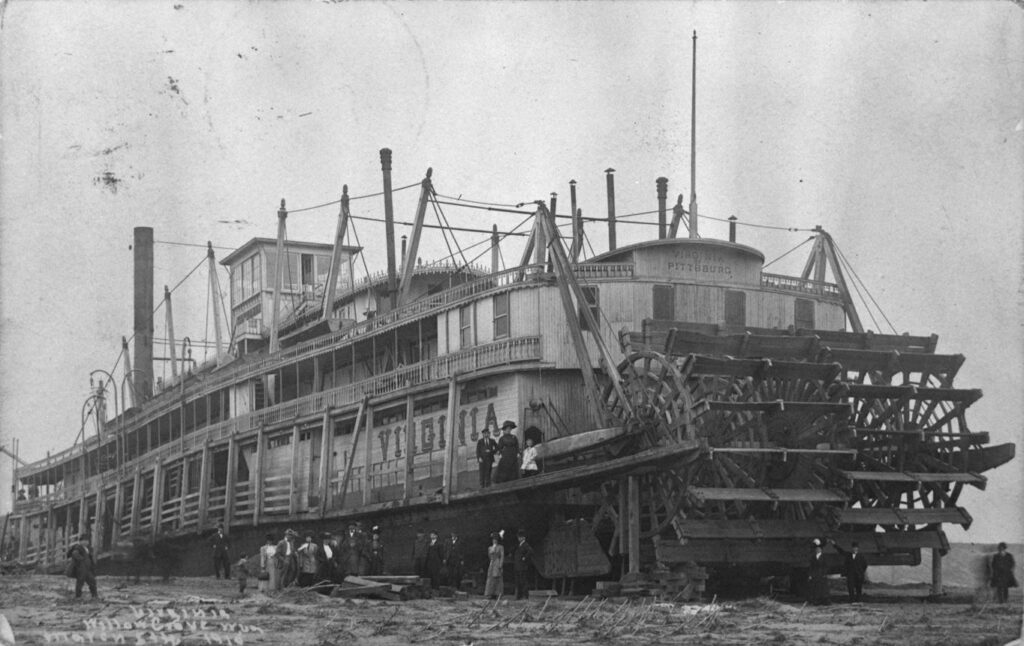
In the spring of 1910, one of the strangest accidents in American river history unfolded along the Ohio River near Willow Grove, West Virginia, when the sternwheel steamboat Virginia somehow became marooned nearly half a mile inland after floodwaters carried it far beyond the river’s normal channel.
When the water finally receded, residents found themselves staring at an almost unbelievable sight:
A 235-foot steamboat sitting in the middle of a cornfield.
A Historic Flood Changed Everything
The bizarre story began during the devastating Ohio River flood of March 1910, which pushed water levels to dangerous heights throughout portions of the Ohio Valley.
According to historical accounts documented by river historians and later chronicled in Steamboat in a Cornfield by John Hartford, floodwaters rose so dramatically that normal landmarks disappeared beneath the river, making navigation exceptionally dangerous even for experienced pilots.
The Virginia, a large sternwheel steamboat operating on the Ohio River, was moving through flood conditions near Willow Grove, West Virginia, when darkness and high water reportedly combined to create a disastrous mistake.
According to historical accounts, the pilot mistakenly identified a farmhouse lantern glowing in the distance as a river navigation signal.
Without realizing it, the captain slowly guided the vessel away from the true river channel and directly into floodwaters that stretched deep into surrounding farmland.
At the time, there was little reason for immediate concern.
The surrounding landscape remained completely underwater, making it difficult to distinguish farmland from the swollen river itself.
But nature had other plans.
The River Left—The Boat Did Not
Over the following days, floodwaters slowly began retreating.
As the Ohio River returned to its banks, something extraordinary happened.
The Virginia stayed exactly where it was.
By the time waters fully receded, the enormous 235-foot sternwheeler sat stranded nearly half a mile from shore, resting awkwardly in what had once been rows of corn.
Residents reportedly could hardly believe what they were seeing.
Instead of floating peacefully on the Ohio River, one of the region’s largest riverboats had somehow become a permanent-looking fixture in farmland.
Photographs from the period show the absurd image of the giant vessel towering over fields where crops would normally grow.
And word spread quickly.
Thousands Came Just to See It
In an era long before viral videos or social media, the stranded steamboat quickly became one of the biggest attractions in the region.
According to historical accounts, thousands of curious visitors traveled to Willow Grove simply to witness the bizarre sight for themselves. Excursion trains reportedly brought tourists daily, while other steamboats on the Ohio River offered special passenger trips so people could glimpse what newspapers began calling the famous “steamboat in a cornfield.”
For local communities, the strange accident became something between a tourist attraction and regional legend.
People posed for photographs.
Families traveled to see it.
Newspapers across the country covered the story because it felt almost impossible to believe.
After all, how often does a giant riverboat end up stranded in a farm field?
Months Passed Before Rescue Finally Came
Despite the public fascination, freeing the Virginia proved far more difficult than anyone expected.
Moving a massive riverboat across dry farmland was virtually impossible with the technology available at the time. Crews explored options, but for months the steamboat remained trapped exactly where floodwaters had abandoned it.
Then nature intervened once again.
In June 1910, rising river waters returned to the area, creating just enough depth for rescuers to finally float the stranded vessel free.
After spending months marooned in farmland, the Virginia was eventually guided back to the Ohio River where it could resume normal operations.
The impossible had somehow become temporary.
A Story That Refused to Die
More than a century later, the story of the Virginia remains one of America’s strangest river legends.
The bizarre event later inspired musician and author John Hartford to write Steamboat in a Cornfield, helping preserve the story for future generations fascinated by the strange history of America’s river culture.
What makes the tale endure is not simply the accident itself.
It is the image.
A giant riverboat sitting impossibly among rows of corn feels almost too ridiculous to be real.
Yet somehow, it happened.
The Bottom Line
In March 1910, floodwaters from the Ohio River carried the 235-foot sternwheel steamboat Virginia into farmland near Willow Grove, West Virginia, after the pilot reportedly mistook a farmhouse light for a navigation signal. When the floodwaters disappeared, the giant vessel sat stranded in a cornfield nearly half a mile from shore, drawing thousands of tourists eager to witness one of the strangest sights in American history.
For months, the steamboat remained stuck where the river left it.
And for more than a century, people have continued asking the same question:
How in the world does a steamboat end up in a cornfield?