
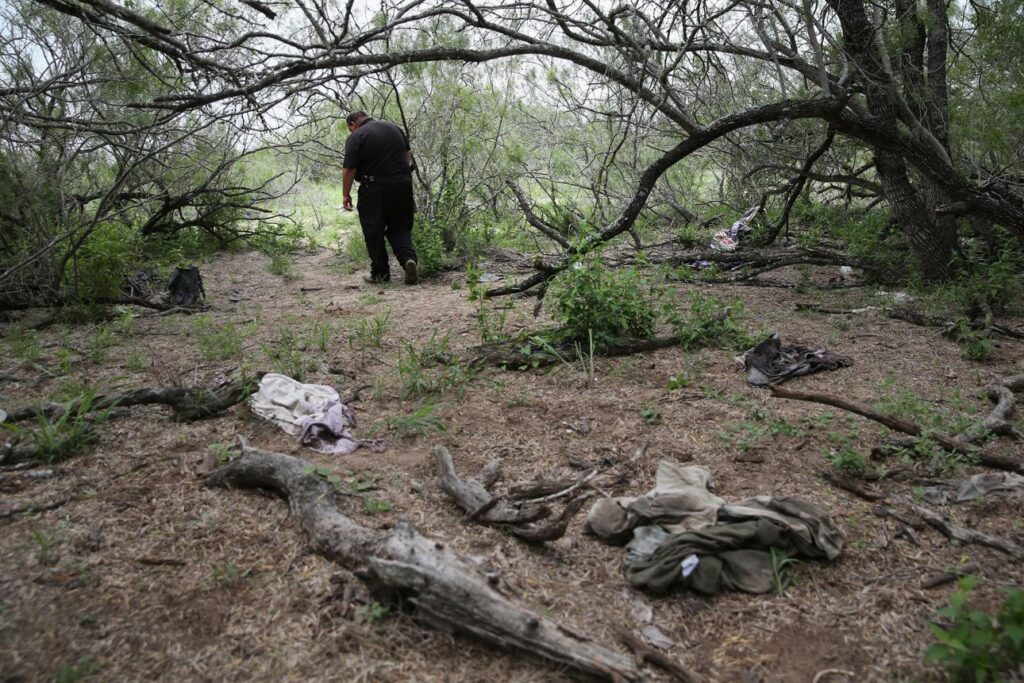

For one South Texas ranch owner, what began as an ordinary morning checking fences quickly turned into something far more unsettling after he reportedly discovered evidence that strangers had been quietly living deep inside his property.
At first, the signs seemed easy enough to dismiss. While driving through a remote section of the ranch, the landowner noticed a discarded water bottle resting near a fence line. Farther down the sendero, there were food wrappers tangled in brush and footprints pressed into the dusty ground. In rural South Texas, odd discoveries occasionally happen. Hunters sometimes wander onto neighboring land, trash gets carried by the wind, and trespassers are not entirely uncommon. But something about this felt different.
The farther he traveled into the property, the more obvious it became that this wasn’t random litter or someone simply passing through. According to the ranch owner, the brush appeared disturbed in ways he had not noticed before. Small branches had been bent repeatedly, and what looked like a narrow walking path had formed through thick mesquite cover. It was clear that someone had been using the same route over and over again.
A Discovery Hidden in the Brush
Concerned and increasingly curious, the ranch owner reportedly followed the path deeper into a heavily wooded portion of the ranch. What he found waiting beneath the trees stopped him cold.
Hidden beneath dense mesquite limbs and carefully concealed by natural cover sat what appeared to be a makeshift camp. Blankets had been spread across the ground in sleeping areas. Empty cans of food and discarded packaging surrounded a small fire ring blackened from repeated use. Plastic jugs of water had been tucked into shaded areas, while tarps stretched between low branches created shelter from the brutal South Texas heat.
The location appeared intentionally hidden. From even a short distance away, the campsite would have blended naturally into the brush, making it nearly impossible to spot unless someone walked directly into the area.
That realization is what reportedly unsettled the ranch owner the most.
This was not evidence of somebody stopping briefly to rest before moving on. Whoever had been there appeared to have stayed long enough to establish a routine, creating temporary shelter in a place far from roads, homes, or public access.
“You realize someone has been staying out there,” the ranch owner later reportedly told neighbors while describing the discovery. “That’s the part that makes you stop and think.”
Why Camps Like This Are Sometimes Found
Across portions of South Texas, hidden camps like this are not unheard of. According to the Texas Department of Public Safety, ranchland near the southern border frequently intersects with routes used by migrants and human smuggling organizations. The combination of remote terrain, heavy brush, and vast acreage creates conditions where temporary camps can remain hidden for days or even weeks.
The Texas Border Sheriffs’ Coalition has stated that makeshift camps are occasionally discovered on private ranches, often containing bedding materials, food containers, clothing, and evidence that multiple individuals had occupied the space. In many cases, the camps are abandoned before law enforcement arrives, leaving behind only signs that people had been there.
For many landowners, however, the experience feels deeply personal.
A ranch is more than acreage on a map. It represents livelihood, privacy, and security. The realization that unknown individuals may have quietly moved through—or even lived on—a property without permission can leave owners feeling uneasy in ways they did not anticipate.
The Questions That Follow
After finding the camp, the ranch owner reportedly found himself asking questions he had never seriously considered before.
How long had people been staying there?
How many had passed through?
Were they still nearby?
According to the Texas Farm Bureau, ranchers in border regions have increasingly voiced concerns over trespassing, cut fences, abandoned belongings, and damage tied to unauthorized crossings. Some landowners report finding clothing, backpacks, or makeshift bedding hidden in creek beds or dense brush. Others describe noticing unusual vehicle tracks or gates left open where livestock could escape.
In many cases, the concerns extend beyond property damage and into personal safety.
Why Authorities Recommend Caution
After making the discovery, the ranch owner reportedly contacted authorities rather than continuing to search the area alone. According to recommendations from the Texas Department of Public Safety, landowners are encouraged not to confront unknown camps or individuals without assistance.
Officials note that many migrants encountered in remote areas are often exhausted, dehydrated, and simply trying to survive difficult conditions. At the same time, law enforcement warns that smuggling activity can overlap with these areas, creating situations that may be unpredictable or unsafe.
By the time authorities later checked the location, the camp reportedly appeared abandoned. Still, signs of recent activity remained. Footprints crossed the dirt near the site, bedding materials stayed in place, and food containers suggested people had occupied the area not long before.
A Reminder of a Larger Reality
For one South Texas ranch owner, the discovery was a reminder that the national immigration debate often plays out far from headlines and political speeches. According to the U.S. Customs and Border Protection, South Texas remains one of the busiest areas for unauthorized crossings, particularly through large ranch properties where thick brush and remote terrain make travel—and enforcement—difficult.
For supporters of stronger border security, stories like this highlight concerns about trespassing, safety, and the burden placed on private landowners. Others emphasize the humanitarian reality that many migrants crossing these properties are fleeing poverty, instability, or violence and often face dangerous conditions of their own.
But for one ranch owner, politics felt secondary to what he found.
Because once someone discovers evidence that strangers have quietly been living unseen on private land, the property never quite feels the same. Every unfamiliar sound in the brush gets attention. Every movement near a fence line raises questions. And every trip back into the far corners of the ranch comes with the lingering thought that someone may have been watching from much closer than anyone realized.