
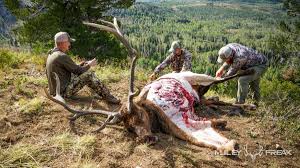
It was supposed to be the perfect end to a hard-earned hunt.
After days of glassing ridges, hiking miles through steep country, and waiting for the right opportunity, the hunter finally had his elk down. Alone in the backcountry, miles from the nearest road and hours from help, he began the careful work every big game hunter knows well — field dressing the animal.
That’s when everything went wrong.
One slip of the knife turned a successful hunt into a life-threatening emergency. And the only thing that stood between him and disaster was a simple roll of plastic wrap buried in his pack.
The Moment Everything Changed
Field dressing an elk is not a small task. The animal can weigh 600 pounds or more, and breaking it down in remote terrain requires precision, patience, and sharp tools.
According to the hunter’s account, he was working methodically when his knife suddenly slipped. Whether it caught bone, hide, or simply shifted in his grip, the result was immediate and severe. The blade sliced deeply into his leg.
At first, shock masked the pain. But the bleeding didn’t stop.
He quickly realized this wasn’t a minor cut. Blood was flowing heavily, and he was alone.
There was no cell service. No nearby help. No quick way out.
In the backcountry, even a relatively small injury can become fatal if bleeding isn’t controlled.
Alone, Bleeding, and Miles From Help
The hunter immediately applied pressure using what he had available — cloth, gauze, anything within reach. But the location and severity of the wound made it difficult to stop the bleeding completely.
He knew he needed to stabilize the injury quickly if he was going to make it out.
That’s when he remembered something he had packed almost as an afterthought: a roll of Saran wrap.
It wasn’t there as medical equipment. He had brought it to help protect meat during the packing process. But in that moment, it became something far more important.
Turning Plastic Wrap Into a Lifeline
Plastic wrap has a unique property that makes it surprisingly useful in emergencies. It can create tight, consistent pressure over a wound while also sealing it from contamination.
The hunter wrapped the plastic tightly around his leg, securing the makeshift bandage and compressing the wound. Layer after layer, he built pressure until the bleeding slowed.
It wasn’t perfect. But it was enough.
The plastic wrap held everything in place and allowed him to regain control of the situation.
Without it, he may not have been able to stop the bleeding long enough to survive the journey out.
The Long Walk Toward Rescue
Stopping the bleeding was only the first challenge. He still had to get out.
With no immediate rescue available, he began the slow, painful process of hiking back toward civilization. Every step was deliberate. Every movement risked reopening the wound.
The plastic wrap continued to hold, maintaining pressure and preventing the injury from worsening.
Hours passed. The terrain was unforgiving. But he kept moving.
Eventually, he reached an area where he could signal for help. Rescue personnel were able to reach him and transport him to medical care.
Doctors later confirmed that the quick thinking and improvised pressure bandage had likely saved his life.
Why Plastic Wrap Worked
While it’s not a substitute for proper medical gear, plastic wrap can be effective in controlling bleeding when used correctly.
It creates even pressure across the wound surface and helps hold dressings in place. It’s lightweight, waterproof, and strong enough to maintain compression.
Medical professionals sometimes use specialized plastic films in hospital settings for similar purposes — particularly for large wounds.
In this case, the hunter’s improvisation bought him the time he needed.
Time is everything in remote medical emergencies.
A Reminder of Backcountry Reality
This incident highlights a truth every backcountry hunter understands: you are your own first responder.
When you’re miles from help, preparation and decision-making matter more than anything else. Accidents can happen in seconds, even to experienced hunters.
Sharp knives, heavy animals, steep terrain, and physical exhaustion create real risk.
Having basic medical supplies — and the knowledge to use them — can mean the difference between life and death.
Lessons Worth Carrying
The hunter recovered, but the experience left a lasting impression. A simple household item became a lifesaving tool because it was available when needed.
Plastic wrap isn’t typically considered emergency gear. But its ability to create compression and protect wounds makes it surprisingly valuable in remote situations.
More importantly, the story underscores the importance of being prepared and thinking clearly under pressure.
In the wilderness, there are no guarantees. Rescue isn’t immediate. Help isn’t always coming quickly.
Sometimes, survival comes down to what you have with you — and how you use it.
In this case, a roll of Saran wrap wasn’t just packing material.
It was the difference between tragedy and walking out alive.