
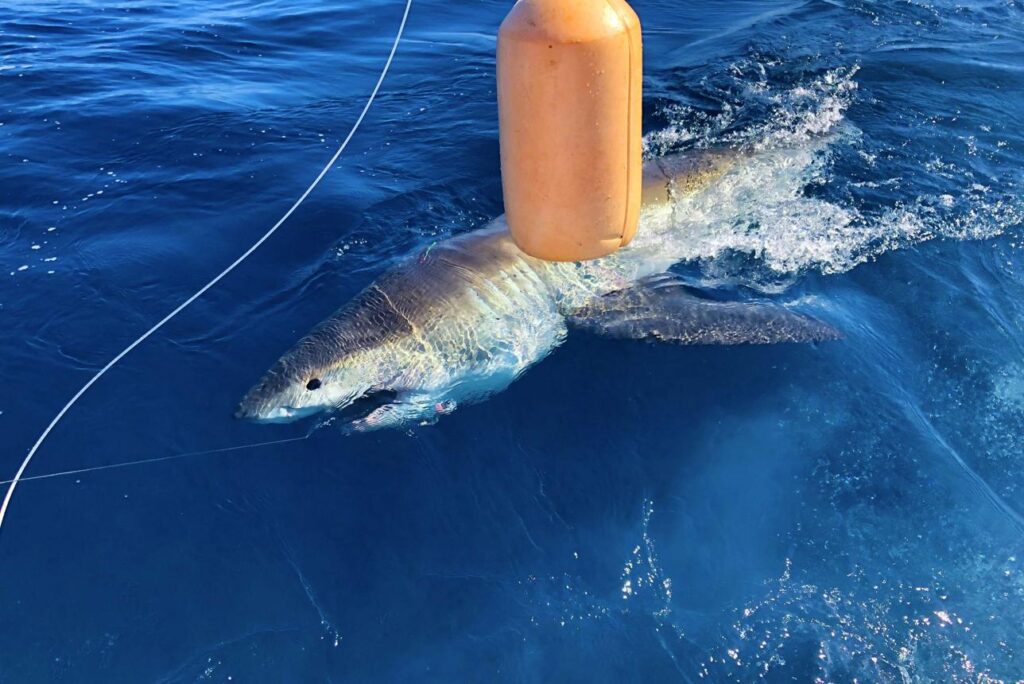
Great White Sharks in the Gulf? Decades of Sightings Suggest a Hidden Pattern

For years, great white sharks have been considered rare in the Gulf of Mexico—something you might hear about occasionally, but not expect to see with any consistency. But a growing body of documented sightings is challenging that assumption in a major way.
According to a comprehensive Gulf sightings database updated through April 2026, great white sharks have been recorded in the region for nearly a century, suggesting their presence is far more consistent than many people realize .
Historical Records Show Great Whites Have Been Here for Decades
The idea that great whites are newcomers to the Gulf doesn’t hold up when you look at the historical data.
Records compiled in the database show confirmed catches and sightings dating back to the 1930s, including longline captures off Florida and documented reports of large sharks off Texas and Louisiana waters . Additional reports from the 1950s describe sharks over 11 feet being caught near Port Aransas, Texas, further reinforcing that these animals have long been present in the region .
By the late 1970s, dozens of great white sharks had already been recorded as bycatch in Gulf fisheries, particularly in Florida waters, according to the same dataset .
Modern Sightings Are Increasing—and Harder to Ignore
What’s changed in recent years isn’t necessarily the presence of great whites—it’s the visibility of them.
According to the database, sightings have increased significantly from 2010 through 2026, driven by more anglers, divers, and offshore workers documenting encounters with photos and video .
Examples include:
- A 2,500-pound great white caught near Florida in 2013
- Sharks filmed near oil rigs and offshore structures
- Multiple sharks caught from shore along the Gulf Coast
- Drone footage capturing sharks close to beaches
More recent reports from 2024 through 2026 include multiple sharks ranging from roughly 8 to 17 feet being filmed, caught, or observed in Gulf waters, particularly along Florida’s coast .
Florida Panhandle Emerges as a Consistent Hotspot
One of the clearest trends in the data is geographic concentration.
According to the compiled sightings, the Florida Panhandle—specifically areas like Pensacola, Destin, Navarre Beach, and Panama City—has become one of the most consistent regions for great white encounters .
Recent documented activity in that region includes:
- A 14-foot shark filmed offshore near Destin in 2025
- Multiple sharks caught near Navarre Beach in early 2026
- Sharks filmed from shore and drone footage near Pensacola
These repeated encounters suggest the area may be part of a regular movement pattern rather than random appearances.
Other Gulf Regions Show Repeated Activity
While Florida stands out, the data also highlights other key areas where sightings cluster.
According to the same database, repeated sightings have occurred near:
- The Chandeleur Islands off Louisiana, particularly around barrier islands and offshore drop-offs
- The Straits of Florida, which appear to serve as a movement corridor between the Atlantic and Gulf
- Offshore reef systems like the Flower Garden Banks, where tagged sharks have been detected
These locations share common features such as deep water access, strong currents, and high concentrations of prey, all of which are known to attract large predatory species .
Not Every Large Shark Is a Great White
Despite the growing number of reports, experts caution that misidentification is still a factor.
According to the database, species like bull sharks are commonly mistaken for great whites, especially in low visibility conditions or brief encounters from boats .
However, many of the sightings included in the dataset are supported by video footage, verified catches, or cross-referenced reports, increasing confidence in the overall trend.
What the Data Suggests About the Gulf Ecosystem
The consistency of sightings across decades points to a broader conclusion: great white sharks are not just occasional visitors to the Gulf of Mexico.
According to the compiled analysis, the data suggests:
- Great whites appear in predictable regions
- Offshore structures and productive fishing areas are common encounter zones
- Seasonal patterns likely influence their presence
These findings indicate a more established presence than previously assumed, even if it has gone largely unnoticed by the general public .
The Bottom Line
The narrative around great white sharks in the Gulf is changing.
What was once considered rare is now supported by decades of documented sightings, modern video evidence, and consistent regional patterns. According to the April 2026 sightings database, the evidence points toward a clear conclusion: great white sharks have likely been a regular part of the Gulf ecosystem for far longer than most people realized .
They’re not new to the Gulf—we’re just finally starting to connect the dots.