
How WWII Hunters Helped Create the Modern Sniper Rifle

When most people picture a sniper rifle, they imagine a highly specialized military weapon built exclusively for combat—heavy barrels, precision optics, and technology designed for extreme long-range accuracy.
But the truth is far more interesting.
Many of the ideas behind today’s sniper rifles did not begin in military laboratories. In many ways, they began with hunters.
During World War II, armies around the world discovered something important: some of the best marksmen on the battlefield were not career soldiers at all. They were hunters, ranchers, and outdoorsmen who had spent years learning how to shoot in difficult conditions. In some cases, soldiers even had personal hunting rifles shipped overseas because military-issued rifles simply were not always accurate enough for specialized long-range work.
That unlikely connection between hunting camps and battlefields helped shape what would eventually become the modern sniper rifle.
Why Hunters Became Natural Sharpshooters
Long before formal sniper schools existed, many rural Americans already possessed skills that translated naturally into battlefield marksmanship.
According to historians at the National WWII Museum, many soldiers entering service during World War II grew up hunting deer, coyotes, rabbits, and varmints. For rural recruits, estimating distance, controlling breathing, shooting from improvised positions, and understanding wind drift were often second nature.
Military instructors quickly noticed the difference.
A farm kid who had spent years shooting at coyotes across wheat fields or squirrels from fence lines often adapted faster than soldiers who had rarely handled firearms before enlistment. Accuracy under pressure mattered, but so did patience, concealment, and observation—skills hunters had quietly developed for years.
According to military historians, some of America’s most effective marksmen came from hunting backgrounds where success depended on one clean shot.
The Problem With Early Military Rifles
Despite producing millions of rifles during World War II, not every military-issued firearm was ideally suited for precision shooting.
The United States primarily relied on the M1903 Springfield and later scoped variants such as the M1903A4 sniper rifle. While effective, early sniper rifles often suffered from limited optics, inconsistent accuracy between rifles, and shortages of purpose-built equipment.
Many soldiers complained that factory-issued sniper setups lacked the precision needed for difficult shots.
According to research from the National WWII Museum and historical military firearms records, commanders often relied heavily on soldiers who already demonstrated exceptional shooting ability, sometimes giving them flexibility to use modified rifles or equipment better suited to accurate shooting.
In some documented cases, especially among Allied and resistance forces, hunters and outdoorsmen used civilian rifles fitted with scopes when military alternatives were unavailable or inadequate.
Hunting Rifles Quietly Influenced Military Thinking
One of the biggest lessons learned during WWII involved rifle design.
Hunters had already spent decades valuing features that military forces would later prioritize in sniper rifles: consistent accuracy, strong bolt actions, dependable optics, and cartridges capable of performing at distance.
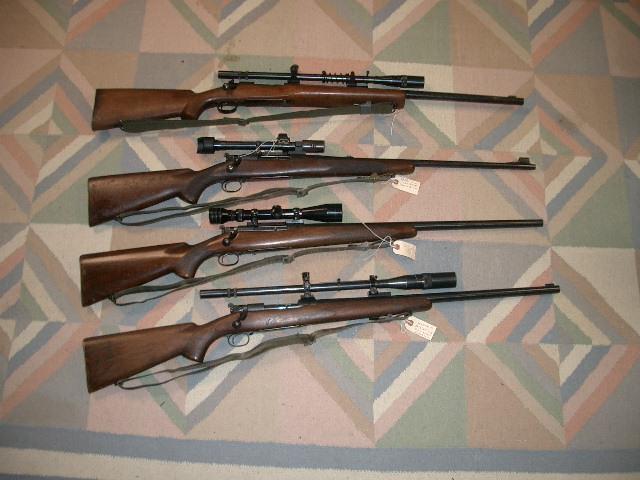
Rifles such as the Winchester Model 70 began earning reputations among marksmen because of their smooth actions and accuracy potential. Introduced in 1936, the Model 70 quickly became popular among hunters, but its precision also caught military attention in later decades.
According to firearms historians, the Model 70 eventually saw limited military use during conflicts such as the Korean War and the Vietnam War as sniper rifles before purpose-built sniper platforms became more standardized.
That crossover between hunting and military rifles was no accident.
Military planners increasingly recognized that many characteristics prized by serious hunters also mattered to battlefield sharpshooters.
Scopes Changed Everything
Before WWII, scoped rifles existed but were far from common in military service.
Many soldiers still relied primarily on iron sights.
The war dramatically accelerated optic development.
According to the Smithsonian Institution, military demand pushed manufacturers to improve scopes, mounting systems, durability, and precision during wartime. Although early optics lacked the clarity and ruggedness of modern glass, they proved the value of magnified shooting under battlefield conditions.
Hunters benefited from those improvements after the war.
Returning veterans who had experienced scoped rifles overseas increasingly embraced optics for deer hunting and varmint shooting back home. In many ways, wartime advancements accelerated the popularity of scoped hunting rifles across America.
That influence still exists today.
Most modern deer rifles now wear scopes that would have seemed revolutionary during the 1940s.
The Birth of the Modern Sniper Rifle
World War II changed how militaries thought about precision shooting.
Before the war, sharpshooting often felt secondary to mass infantry tactics. But battlefield experiences in Europe and the Pacific demonstrated the enormous tactical value of highly skilled marksmen capable of engaging threats at distance.
According to military historians at the National WWII Museum, nations increasingly began developing formal sniper doctrine, training programs, and purpose-built rifles after the war.
The modern sniper rifle eventually emerged from a blend of battlefield necessity and civilian influence.
Military engineers improved upon ideas hunters had trusted for decades: strong bolt-action systems, reliable optics, precision barrels, and cartridges capable of consistency at long range.
In many ways, the DNA of today’s sniper rifle can still be traced back to hunting camps.
The Bottom Line
The modern sniper rifle was not created overnight, nor was it built entirely inside military factories.
Its roots stretch back to hunters who understood accuracy long before military doctrine fully embraced precision shooting. During World War II, those hunters carried hard-earned shooting skills into combat, while hunting rifle technology quietly influenced how militaries approached long-range marksmanship.
The result was something entirely new.
A rifle built for precision.
A system designed around one carefully placed shot.
And a legacy that still connects deer woods to battlefields more than most people realize.