
One Country Has a Right—The Other Has Permission. Here’s the Difference
A Freedom Unlike Most of the World
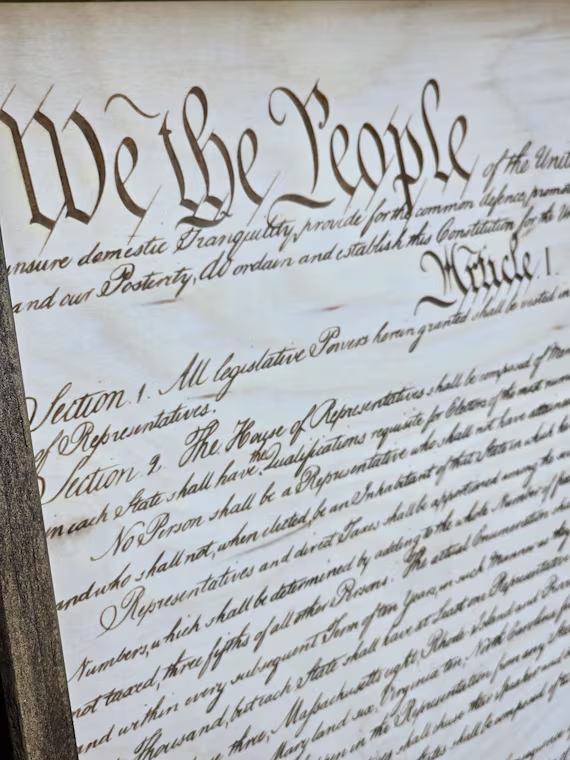
In the United States, the right to keep and bear arms is protected by the Second Amendment—one of the most debated yet uniquely American freedoms.
While many Americans grow up taking this right for granted, a quick comparison to other developed nations shows just how rare it really is.
Countries like Canada, which share a similar culture and border with the U.S., take a very different approach to firearms ownership. That contrast highlights why many Americans view the Second Amendment not just as a right—but as a defining part of personal freedom.
The Foundation of the Right
The Second Amendment was established as part of the Bill of Rights in 1791, rooted in the idea that citizens should have the ability to defend themselves and, if necessary, resist tyranny.
Over time, that principle has evolved into a broader cultural and legal framework supporting:
-
Personal self-defense
-
Hunting and outdoor traditions
-
A check on government power
For many Americans, it represents independence and responsibility as much as it does protection.
How Canadian Gun Laws Compare
Canada allows civilian firearm ownership—but under significantly stricter controls.
To legally own a firearm in Canada, individuals must:
-
Pass a federal licensing process
-
Complete mandatory safety training
-
Undergo background checks and waiting periods
According to the Royal Canadian Mounted Police, all firearm owners must obtain a Possession and Acquisition Licence (PAL), and certain types of firearms are heavily restricted or outright prohibited.
Handguns, in particular, have faced increasing limitations in recent years, including a federal freeze on new handgun purchases and transfers.
Unlike in the U.S., firearm ownership in Canada is considered a privilege regulated by the government—not a constitutional right.
Freedom vs. Permission
That difference—right versus privilege—is at the heart of the debate.
In the United States, the Constitution limits how far the government can go in restricting firearm ownership.
In Canada, the government has broader authority to regulate or restrict access based on policy decisions.
For many Americans, that distinction matters.
It means:
-
You don’t need government approval to exercise a constitutional right
-
Your ability to own firearms isn’t dependent on shifting political policies
-
The right itself is protected at the highest legal level
Cultural Impact in America
The Second Amendment has shaped American culture in ways that go beyond law.
Firearms are deeply tied to:
-
Hunting traditions passed down through generations
-
Recreational shooting sports
-
Rural lifestyles and land management
According to data from the U.S. Fish and Wildlife Service, millions of Americans participate in hunting each year, contributing billions of dollars to conservation and wildlife management.
In many parts of the country, firearm ownership is simply part of everyday life.
The Self-Defense Argument
Another major component of the Second Amendment is self-defense.
Supporters argue that individuals should have the ability to protect themselves and their families without relying solely on law enforcement.
Response times, location, and circumstances all play a role in personal safety decisions.
For many Americans, the ability to own a firearm provides a sense of security and independence.
The Ongoing Debate
Of course, the Second Amendment is not without controversy.
Debates continue over:
-
Background checks
-
Types of firearms allowed
-
Public safety concerns
Canada’s stricter laws are often cited by those who support more regulation in the U.S.
At the same time, many Americans argue that increased restrictions risk eroding a fundamental constitutional right.
A Unique American Right
Globally, very few countries recognize firearm ownership as a constitutional right.
That makes the Second Amendment relatively unique.
It reflects a broader philosophy embedded in American governance—that individual freedoms should be protected from government overreach.
Why It Still Matters Today
In a rapidly changing world, the Second Amendment remains one of the most discussed and defended rights in the United States.
For supporters, it represents:
-
Personal responsibility
-
Individual liberty
-
A safeguard against excessive government control
Comparing it to countries like Canada underscores just how different the American system is.
The Bottom Line
Whether viewed through the lens of self-defense, tradition, or constitutional principle, the Second Amendment stands as a defining feature of American freedom.
It’s not just about firearms—it’s about the idea that certain rights belong to the people, not the government.
And in a world where many freedoms are regulated or restricted, that distinction is exactly why many Americans believe it’s something worth protecting—and being grateful for.